
NewBookFront
For more than a century, quantum mechanics has delivered extraordinary predictive power while remaining conceptually incomplete. It operates with unmatched precision, yet without a clearly identified physical structure underlying its formalism.
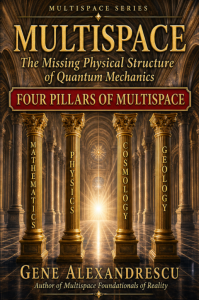
MultiSpace: The Missing Physical Structure of Quantum Mechanics presents a new theoretical framework in which observed reality emerges from a layered architecture of interconnected spaces. Extending Minkowski’s unification of space and time, the book explores the possibility that quantum and classical phenomena unfold across a hierarchy of orthogonal and quasi-orthogonal spaces, embedded within a larger structure referred to as the omnispace.
Within this framework, the familiar universe is interpreted as a local (“soli”) reality inside a broader MultiSpace architecture. Complex and imaginary dimensions are treated as corresponding to real, orthogonal three-dimensional spaces, with complex numbers acting as bridges between them. This perspective allows quantum state spaces to be viewed as physically meaningful domains rather than purely abstract constructs.
Quantum phenomena such as superposition and entanglement are reinterpreted as structural consequences of systems extending across multiple spaces, while the measurement problem is approached as a transition between these domains. The framework does not replace quantum mechanics but seeks to situate it within an explicit physical structure.
The book develops its proposal across multiple domains, including a Multispace Algebra in mathematics, foundational questions in physics, cosmological models such as the Cosmhole Hypothesis, geological implications through the Expanding Earth model, and the role of the observer within this extended architecture of reality.
Written for physicists, philosophers of science, and mathematically inclined readers, this first volume of the MultiSpace Series offers both a technical framework and a broader conceptual proposal for reexamining the foundations of physical reality.